Posts

Showing posts with the label soil health

Soil Your Undies For Science

Image
Soil Your Undies Challenge The Soil Your Undies Challenge is an experiment to find out how healthy your soil is and see the amazing work being done in the soil beneath our feet. Healthy soil gives us clean air and water, bountiful crops and forests, productive grazing lands, diverse wildlife, and beautiful landscapes. The Shiawassee Conservation District conducted their first ever Soil Your Undies Challenge in the summer of 2025. Ten pairs of cotton underwear were “planted”, and nearly all of them were found and “harvested”, showing varying degrees of decomposition.  Soil is a busy community of life! Soil is filled with billions of microorganisms, working together to break down organic matter, hold water, resist erosion, boost nutrient cycling, and support plant growth. The more active these organisms (including bacteria, fungi, and earthworms) are, the healthier your soil will be. Healthy soil = healthy life! The Process Ten pairs of new, 100% cotton underwear were buried in diffe...
Say Yes to No-Till Farming

Image
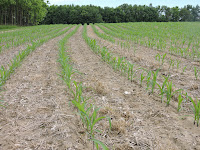
What do you think is the most crucial component in any farming operation? Although equipment, seed, fertilizer, and other farming tools might come to mind, these can all be interchanged or replaced. The soil is the most crucial component. The one constant in any farming operation is the land being farmed. Most farmers strive to do their best to be good stewards of the land because their livelihood depends on the productivity of the soil. One practice that will improve soil productivity and health is no-till farming. No-till farming is a method of growing crops from year to year with minimal soil disturbance. Crop residue is left on the field after harvest, where it acts as a mulch to protect the soil during the winter. No-till farming helps to control soil erosion, keeping the valuable topsoil on the crop field. The following year’s crop is planted with a special planter that cuts a slot through the residue just wide enough to place the seeds in the soil. Conserving soil is not the...

Farm management: Good for you, good for our future

Image
  Keeping nutrients on your field is just as important as keeping them out of our waterways. The same nutrients that are essential for crop growth and profitability are the same nutrients that endanger water when they escape from the field. Sediment, organic matter, fertilizers, and pesticides are all nutrients that can come from farm fields and be transported to water either through erosion or storm runoff. Resource management is not a “one fits all” method. It is best to come up with a practice plan that is specific to your farm and goals. Effective agricultural management requires knowledge of how nutrients move across the land and the impact they have. Luckily, there are many management practices to help protect water and keep nutrients on the land. A soil test is a good starting point. A nutrient management plan can be developed from the soil test results. Following the plan will help keep nutrients on the field and out of the water by following the right rate, at the righ...

Let’s not treat soil like dirt!

Image
  Soil is a living, ever-changing mixture of organic and mineral material, gases, and water. Life within soil is sustained through plant growth, nutrient and organic matter recycling, and water infiltration. Everything on Earth depends on soil, and often this vital resource is overlooked. It is our responsibility to care and nurture the soil so that we can have a healthy planet for us and for future generations. Healthy soil is like a filter. It absorbs and purifies water before it enters our groundwater, lakes, and rivers. Keeping roots in the ground throughout the entire year, minimizing soil disturbance, and reducing compaction creates larger soil pores, which helps increase water infiltration. When more water can penetrate the soil, there is less nutrient and sediment losses, more water available for plants to grow, and more water that is able to filter down into groundwater. When we benefit soil health, we protect water quality. Soil is fragile and can quickly become out o...